
For over a decade, digital marketing operated on a simple rule, the bigger your reach, the more money you make. Programmatic advertising easily cracked the code on scaling up, giving media buyers the power to buy billions of ad slots around the world in the blink of an eye.
But in 2026, pulling in huge volume doesn’t mean you get a good performance.
The web is flooded with junk right now. We deal with sneaky ad arbitrage and massive Made-for-Advertising (MFA) arbitrage networks. On top of that, AI-driven Sophisticated Invalid Traffic (SIVT) that fakes human behaviors like scrolling and clicking.
The challenge lies in separating meaningful engagement from misleading performance metrics. Inefficient supply paths, invalid traffic, ad arbitrage, and low-viewability placements can quietly reduce campaign efficiency, making it difficult to know whether your media spend is reaching real, engaged users. If your key KPI, still is, chasing low-cost CPC volume, your ad spend is mostly just paying for empty, non-converting data signals.
If you want to protect your margins and scale sustainably, your programmatic strategy needs to shift away from tracking raw traffic scale and start verifying human intent.
The Problem with Chasing Cheap Click Volume
A lower CPC or CPM is great, but only if it brings the right kind of traffic. Cost tells you how much you’re paying to reach users, not how valuable those users are. That’s why experienced media buyers look beyond pricing and pay equal attention to viewability, engagement, and post-click behavior.
An ad impression can be counted even if no one sees it like a 1×1 pixel that is hidden or placed behind items on a page. Similarly, clicks are easily manipulated via accidental touches on mobile applications, auto-refreshing background tabs, or malicious scraping bots.
When media buyers focus on the price and not on where the traffic is coming from, they end up choosing low-quality traffic instead of real valuable customers.
Performance Breakdown: Scale-Driven vs Quality-Driven Programmatic Buying
| Performance Indicator | Scale-Driven Framework (Quantity/Legacy) | Quality-Driven Framework (Intent/Modern) |
| Primary Optimization Objective | Maximize total impression volume and hit low-cost CPC benchmarks. | Secure high-intent human interactions with verifiable conversion values. |
| Inventory Verification Mode | Post-campaign reactive blacklists and static keyword exclusions. | Proactive Supply Path Optimization (SPO) and live pre-bid fraud filtering. |
| Targeting Methodology | Broad cookie-based tracking and unverified third-party audience segments. | First-party data orchestration combined with real-time contextual intelligence. |
How to Verify Traffic Quality in Three Steps?
To evaluate if an open-web campaign is delivering genuine opportunity or empty metrics, media buyers should look at these 3 layers:
1. Quality-Adjusted Reach (QAR)
Not every impression contributes equally to campaign performance. While traditional reach measures how many people your campaign was served to, Quality-Adjusted Reach (QAR) shifts the focus to the quality of those impressions. Instead of looking at volume alone, it encourages media buyers to evaluate factors such as viewability, traffic quality, audience relevance, and meaningful engagement. This provides a clearer understanding of whether your campaign is reaching audiences that are more likely to deliver value.
2. Post-Click Behavior Optimization
Authentic and real human traffic demonstrate clear patterns of on-page engagement. Low-quality bot traffic typically bounces instantly or triggers uniform, predictable page actions. High-intent human visitors display irregular scroll patterns, deep text dwell time, and interaction with high-value structural elements such as submission forms, drop-down menus, and media players.
3. Supply Path Optimization (SPO)
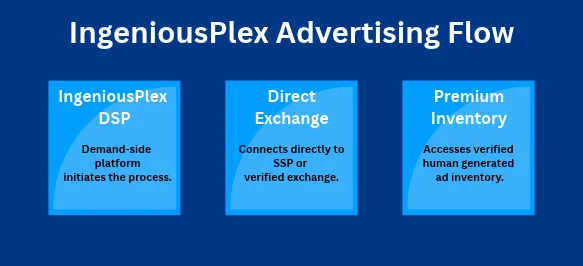
Every intermediary party sitting between a Demand-Side Platform (DSP) and an individual digital publisher dilutes ad spend data transparency. Implementing an intentional supply path optimization strategy cuts out duplicate ad networks and reseller chains. By prioritizing verified supply partners and transparent supply paths, modern DSPs like IngeniousPlex can reduce exposure to unauthorized reseller domains while giving media buyers greater visibility into where their ads are served. This directs a higher percentage of every media dollar straight into premium placements on verified, safe publisher sites.
Contextual Intelligence vs. Legacy Audience Bundling
Previously, cookie-based tracking allowed advertisers to follow an audience segment anywhere across the internet, regardless of the publisher’s site’s baseline quality. This led to high-intent audiences being served critical brand messages on low-tier, distracted web environments like clickbait listicles or spam forums.
context matters just as much as the audience. Instead of following users across the web, Contextual Intelligence looks at the content of a webpage and helps advertisers place ads where they naturally fit. When an ad appears alongside relevant content, it feels more connected to what the user is already exploring, creating a stronger opportunity for meaningful engagement than a placement based only on audience data.
Maximizing Programmatic ROI with IngeniousPlex
Scaling an advertising campaign shouldn’t mean losing visibility of where your budget is going. As campaigns grow, having a clear view of your traffic sources and placements becomes essential to maintaining quality and making better buying decisions.
IngeniousPlex is an AI led programmatic performance DSP built for agencies, brands, traffic and media buyers who care about measurable campaign outcomes, not just surface-level metrics. It brings audience targeting, real-time traffic-source visibility, and precise CPC and CPM bidding into one transparent workflow, giving buyers more control over their campaigns.
With real-time visibility into individual traffic sources and active ad placements, media buyers can quickly spot underperforming inventory and take action before it impacts the campaign. This helps direct budget toward stronger traffic, improve campaign efficiency, and scale performance with greater confidence.
FAQs
1. How do you measure traffic quality beyond raw click volume?
Traffic quality is measured by tracking post-click engagement metrics rather than just the initial click. Key performance indicators include Quality-Adjusted Reach (QAR), deep scroll depth, significant on-page dwell time, low instant-bounce rates, and active user interactions with landing page elements.
2. How does modern programmatic buying help business growth?
It focuses on putting your ads in front of the right people at the right time using Contextual Intelligence. Instead of chasing quick spikes in traffic, this framework builds steady momentum by placing your brand in premium, relevant places.
3. How does Supply Path Optimization (SPO) improve ad campaign performance?
Supply Path Optimization improves performance by eliminating redundant middlemen and reseller networks from the programmatic auction chain. By establishing a direct route from the DSP to verified SSPs and premium publishers, SPO increases data transparency, minimizes transaction fees, and reduces the risk of ad fraud.