
When you buy traffic, the expectation is simple: more website visitors and more leads. But what needs to be understood is that the performance of the campaign is contextual, entirely on what you set out to do. If the goal is clicks, buy on CPC and pay per click. If the goal is reach, buy on CPM and pay per thousand views, since impressions are the point. When the buying model and the goal don’t line up, you end up paying for one thing while hoping for another, and that gap only shows itself at the end of the funnel.
That distinction matters more than ever as advertisers look for better ways to manage their paid traffic campaigns.
What Is Paid Traffic?
Paid traffic is traffic you acquire through advertising rather than unpaid or organic sources. You pay to get your ad in front of an audience and bring users to your website, landing page, app or offer. With Performance Demand Side Platforms (DSP) like IngeniousPlex, advertisers buy media through CPC or CPM. CPC means paying per user clicks, and CPM means paying per thousand impressions. That’s what you’re purchasing, media delivery.
Paid Traffic vs. Delivered Leads: Where’s the Difference?
Consider a campaign:
- A user sees your ad.
- They click it.
- They reach your landing page.
- They look at your offer.
- Then they decide whether to submit a form.
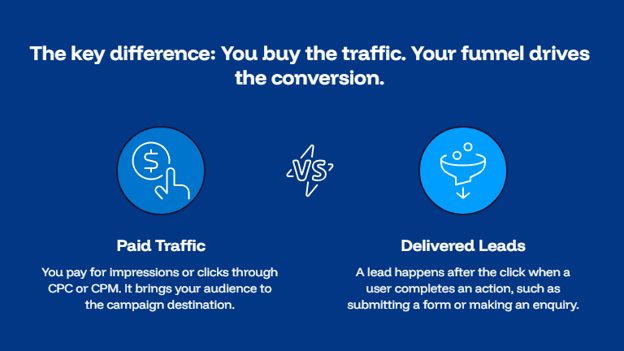
The advertising platform is responsible for delivering the media (whether it is the creative, landing page, tracking or follow-up) and helping reach the intended audience. What happens after the user arrives depends on the rest of the conversion journey. This is where paid traffic and delivered leads need to be viewed differently. Paid traffic gives you impressions and clicks, and a generated lead comes from a user engaging with the creative. The delivered lead goes one step further, it should meet the criteria that you agreed for that delivery. A click creates an opportunity to convert. It doesn’t guarantee a conversion. Sometimes when you don’t get a converted lead, it might happen because of the gaps persisting either in the creative, landing page, tracking or follow-up which disturbs the user’s experience. Spotting that gap early is the difference between a campaign you fix and one that quietly keeps spending.
Paid Traffic Sources Matter More Than Traffic Volume
This is where looking at your paid traffic sources becomes important. Suppose one source generates 10,000 clicks, and another generates 5,000. At first, the former source looks better. But what if the second source produces stronger engagement or more conversions? Suddenly, the volume doesn’t tell you the whole story.
When you buy high-quality traffic, the goal shouldn’t simply be to buy as much traffic as possible. You want to understand where that traffic is coming from, which audiences are responding, and which placements are contributing to campaign performance.
That’s why traffic source visibility matters.
With IngeniousPlex, media buyers can evaluate traffic sources, audiences, placements, and campaign performance and use those insights to make better buying decisions.
Buying Traffic to Your Website? Look Beyond the Click
If the goal of your ad campaign is to drive more users to your website, getting someone to click on the creative is only the beginning.
What happens once they arrive?
Is the landing page relevant to the ad?
Is the offer clear?
Is the form easy to complete?
Does the audience you’re targeting actually have a reason to take the next step?
These questions matter because even excellent paid traffic can underperform when the destination isn’t built to convert. That’s a much more useful way to evaluate a campaign.
CPC or CPM? Start With the Campaign Objective
There is often too much complexity around media buying when the basic question is simple. If you’re buying through CPC model, you’re paying for clicks and if you’re buying through CPM, you’re paying for impressions. The right choice depends on your campaign objective, audience, budget, and overall strategy. But neither model should be confused with a guaranteed number of leads. CPC and CPM define how you pay for the media, they don’t determine what happens after the user sees or clicks on the ad.
What Makes a Paid Traffic Campaign Work?
Good paid traffic marketing isn’t just about getting more traffic. It’s about making better decisions at every stage of the campaign, from understanding the quality to performance of traffic while recognizing what happens beyond media buying.
That means understanding:
- who you’re targeting
- where your traffic is coming from
- which placements are performing
- how your budget is being used
- how your CPC or CPM is performing
- how leads are defined and qualified
- what happens after users reach your destination
This is where having campaign data you can actually act on becomes valuable. Instead of simply buying traffic and waiting for the campaign to finish, media buyers can identify what is working and adjust their strategy along the way.
So, What Are You Actually Buying?
This is the question worth asking before any traffic purchases. If you’re buying media through CPC or CPM, you’re purchasing advertising delivery. You may be using that traffic for awareness, website visits, app growth, lead generation or another business objective. But the traffic itself isn’t necessarily the final business outcome, and a generated lead isn’t automatically the same as a delivered lead that meets agreed criteria.
- You buy the media.
- You build the conversion journey.
- The two must work together.
And if leads are being delivered against the agreed criteria, they must be clear from the start.
That’s where IngeniousPlex fits in!
As a Programmatic Performance DSP for advertisers, agencies and media buyers, IngeniousPlex brings campaign setup, audience targeting, traffic sources, CPC and CPM bidding, campaign management, optimization and reporting into one workflow.
So, if you’re looking to buy traffic or buy targeted website traffic, the better question isn’t simply how much traffic you can get. It’s whether you can reach the right audience through the right traffic sources, with the right campaign strategy. Because ultimately, more traffic isn’t always the goal. Better traffic and better decisions are.
FAQs
1. What is paid traffic?
Paid traffic is website or digital traffic acquired through advertising. Advertisers pay to reach a specific audience and drive impressions or clicks to a website, landing page, app, or other destination.
2. What is the difference between paid traffic and delivered leads?
Paid traffic refers to the impressions or clicks generated through advertising. A delivered lead is a user who completes a desired action, such as submitting a form or making an enquiry. Traffic can create the opportunity for a lead, but traffic and leads are not the same thing.
3. How does CPC differ from CPM in paid traffic?
With CPC (cost per click), you pay for clicks. With CPM (cost per thousand impressions), you pay based on impressions. IngeniousPlex uses both CPC and CPM buying models for programmatic campaigns.
4. How can I improve the quality of my paid traffic?
Start by looking beyond traffic volume. Evaluate your paid traffic sources, audience targeting, placements and campaign performance. Identifying which sources and audiences are contributing to your campaign objectives can help you make better buying decisions.
5. How can IngeniousPlex help with paid traffic?
IngeniousPlex helps advertisers, agencies and media buyers manage programmatic campaigns through CPC and CPM bidding, audience targeting, traffic-source selection, campaign management, optimization, analytics and reporting.